Egyptian & Turkish darbuka: sound, touch and style.
Hear Egyptian ensemble playing and a Turkish teacher’s groove, then explore the techniques behind them.
“Egyptian” and “Turkish” can describe a drum’s construction, a teaching tradition or a player’s musical background. Start by separating the instrument in your lap from the technique you are learning and the music you want to play.
Rim, tone and the first strokes
Sala Muzik’s Turkish comparison illustrates the rounded Egyptian rim and the more exposed fittings on traditional Turkish metal models. The rim, head, size and tuning all affect how a drum feels to play. [1]Sala Muzik · Turkish / Egyptian construction (Turkish)tr.salamuzik.com
In his Arabic-language i‘zif lesson, Nasser Salameh starts with Dum and Tak, includes changes in volume, and asks learners to work slowly for a clear sound. Try alternating low and high strokes without letting either become louder by accident. Ka names the alternate-hand rim sound in the player. [2]Nasser Salameh / i‘zif · Dum and Tak (Arabic)izif.com
Egyptian and Turkish playing
Listen to Egyptian tabla master Sa‘id al-Artist with his percussion ensemble, a performance selected by MaqamWorld. Follow a repeating phrase first, then choose one other part to listen to. A complete performance gives you more to learn from than a fast fill in isolation.
 Watch demonstration
Sa‘id al-Artist and his percussion ensemble
Egyptian percussionist · Al-Geneina Theatre performance
Watch & try. Choose a short passage and follow the low strokes through it. On a second listen, attend to the brighter sounds and the group’s shared accents.
Nahed Samir · MaqamWorld · Arabic tabla reference (English)
Hakan Kaya distinguishes an older Turkish approach called fiske from modern split-hand playing. His account places fiske in Turkish classical music. [3]Hakan Kaya · Fiske and split-hand (English)learndarbuka.com
Kaya credits Mısırlı Ahmet with developing split-hand technique. He describes index and ring fingers in both hands, with the little finger in some combinations, and notes its use on clay and metal drums. Learn the movements from a teacher or close-up lesson before trying to turn them into a continuous roll. [3]Hakan Kaya · Fiske and split-hand (English)learndarbuka.com
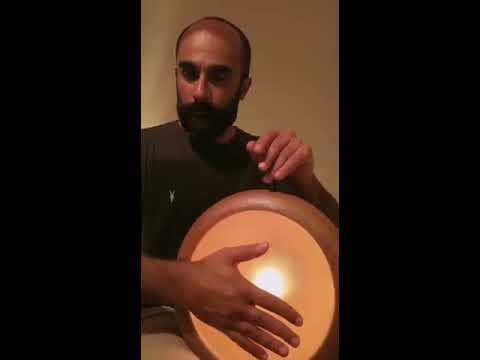
In this public group-lesson excerpt, Hakan Kaya demonstrates his own ornamented 2/4 groove. It offers a listening example of how a recurring phrase can carry extra detail.
 Watch demonstration
Hakan Kaya: a 2/4 groove with ornaments
Turkish percussionist · Group lesson demonstration
Watch & try. First follow the repeating pulse without copying the ornaments. Then pick one brief figure to observe. Return to an easy pattern on your drum and check that adding detail does not move the next downbeat.
Sonika Percussion · Hakan Kaya · A 2/4 groove with ornaments (English)
Bring ideas into your own playing
Listen to complete performances as well as technique clips. Notice accompaniment, space, accents and the relationship with a singer or dancer. Try ideas from both approaches. A relaxed, well-placed phrase is a useful goal in any tradition.
Play four bars of Basic Maksum at a comfortable tempo. Work on one small ornament separately, then place it near the end of the fourth bar and return clearly to beat one. Record the result and listen for changes in timing or volume.