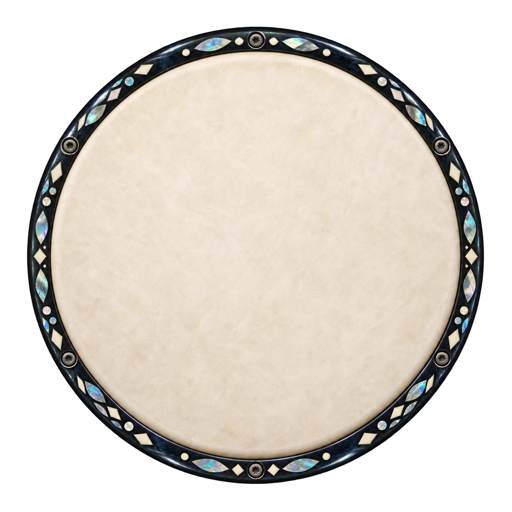
Different types of darbuka, explained.
Egyptian and Turkish shapes, clay and metal shells, and the difference between standard, Sombaty and Dohola drums.
A darbuka’s wide head, narrow waist and open base give it a recognisable silhouette, but instruments within that family can feel very different. The names describe several things at once: a regional design, a body material or a size. An Egyptian-style drum can also be a metal Sombaty with a synthetic head. Understanding those layers makes the labels easier to read.
A visual guide to darbuka types
Start with size: standard, Sombaty and Dahola. Then look at material and construction: clay or metal, a rounded Egyptian rim or exposed Turkish fittings. These labels can describe the same drum.
Photographs are shown at different scales. Sizes and names vary by maker; the listed measurements describe these examples. Select a photograph to see it at full size.
 Open the original photo ↗
A familiar solo-size choice with a rounded Egyptian rim. Gawharet El Fan’s Sapphire Orchid range includes a 22 cm option.
 Open the original photo ↗
A larger playing area within the Egyptian size family. The maker lists this Dark Flower Sombaty with a 23 cm head and 48 cm height.
 Open the original photo ↗
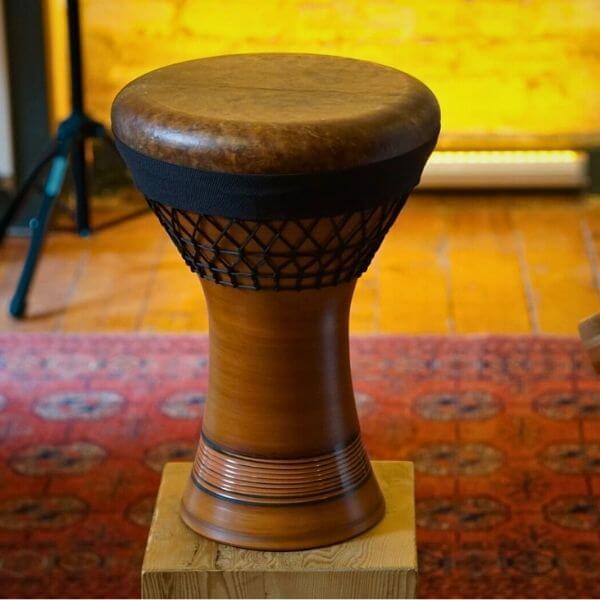
The larger bass member, also called Dohola or Doholla. This Sonika clay example has a 27 cm skin head and is 51 cm tall; metal bass models exist too.
 Open the original photo ↗
Look for the ceramic body and skin binding. Clay describes the shell material: it can be a solo drum or a larger bass drum, like the example above.
 Open the original photo ↗
Notice the exposed tuning ring and bolts around the head. Compare that edge with the rounded rims of the Egyptian examples.
Know the parts.
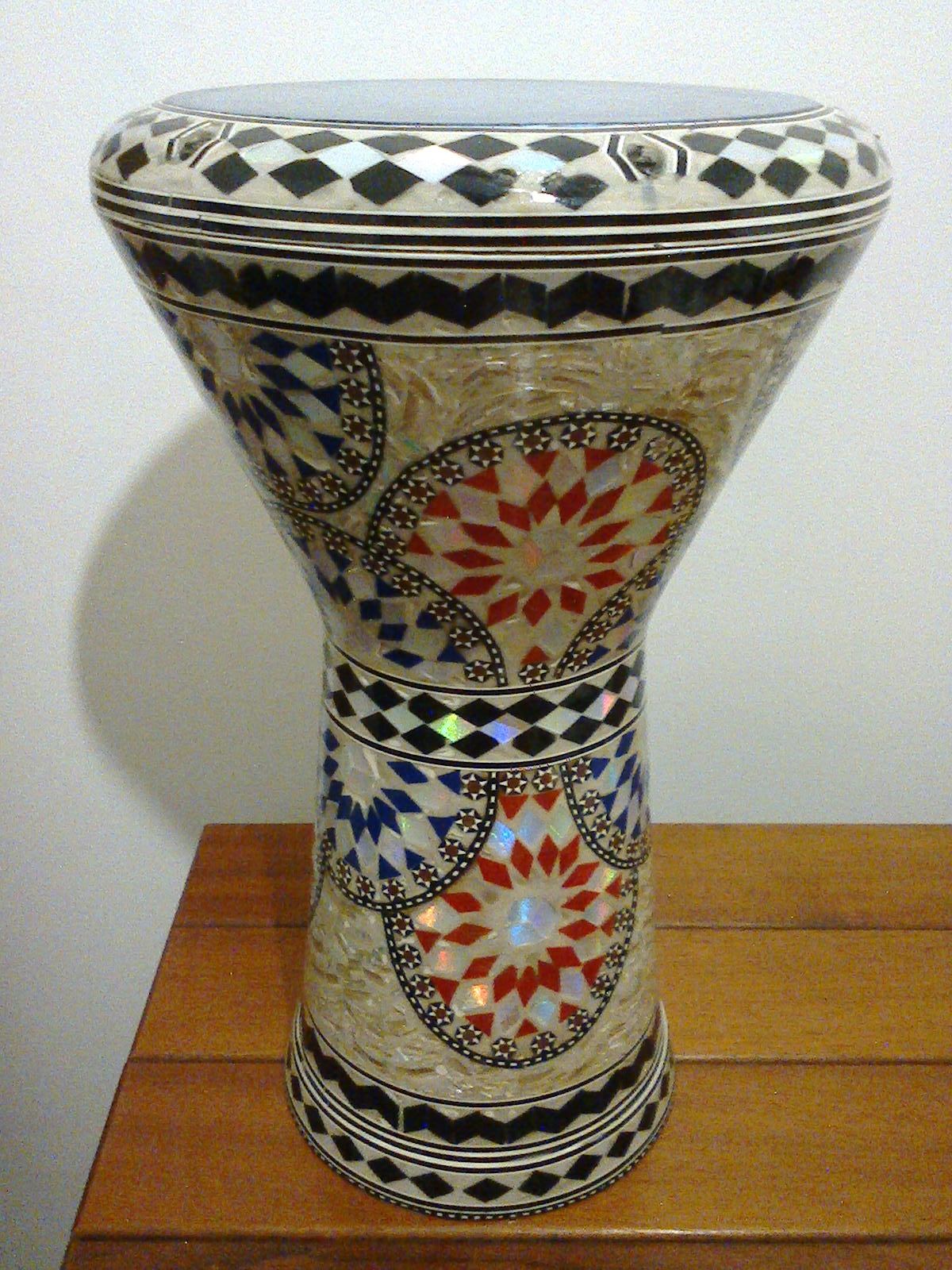
- 1Head
- The stretched skin or plastic sheet you strike to make a sound.
- 2Rim
- The edge around the head. Its shape affects how your hands meet the drum.
- 3Shell
- The hollow body under the decoration.
- 4Waist
- The narrow part of the goblet shape, between the bowl and the foot.
- 5Foot / open base
- The lower end widens out again. It has an open bottom, with no second drumhead.
A Cairo-made darbuka with a rounded rim and decorated body, photographed in 2013.
Photograph: Siffert80 · Darbuka do Cairo · Annotations: Practice Lab · CC BY-SA 4.0
Shapes, materials and finishes
Sala Muzik’s Turkish guide contrasts the rounded Egyptian rim and recessed fittings with the more exposed hardware of Turkish metal models. MaqamWorld describes modern Arabic tabla construction as aluminium with a replaceable, tunable plastic head. [1]Sala Muzik · Turkish / Egyptian construction (Turkish)tr.salamuzik.com[2]MaqamWorld · Arabic tabla reference (English)maqamworld.com
Turkish-style metal darbukas often have visible tuning bolts and a more exposed edge, as shown in Sala Muzik’s instrument guide. Check how that edge meets your fingers and whether the fittings leave your hands room to move. [3]Sala Muzik · Materials, heads and care (English)salamuzik.com
MaqamWorld documents traditional clay tabla with natural skin fixed using glue and woven threads. Egyptian maker Gawharet El Fan also includes clay drums in its own history. Turkish teacher Hakan Kaya describes clay darbuka as a common instrument for split-hand playing. [2]MaqamWorld · Arabic tabla reference (English)maqamworld.com[4]Gawharet El Fan · An Egyptian maker’s designs (English)gawharetelfan.com[5]Hakan Kaya · Fiske and split-hand (English)learndarbuka.com
Decoration and construction are separate choices. Gawharet El Fan’s Dark Flower Sombaty lists an aluminium inner shell, mother-of-pearl decoration and a plastic head. Appreciate the inlay, then separately compare the rim, weight and sound. [6]Gawharet El Fan · Dark Flower construction (English)gawharetelfan.com
Sizes, heads and care
Darbukas come in several sizes, from solo drums to larger bass drums. Gawharet El Fan describes Sombaty as an enlarged darbuka with more playing area. Turkish retailer Donizetti distinguishes standard, Sombaty and bass-oriented Dohola models in its Egyptian-drum guide. Dahola, Dohola and Doholla are spellings you may encounter for the bass member. Names are a starting point; compare the actual head diameter, height and weight. The main size families are: [4]Gawharet El Fan · An Egyptian maker’s designs (English)gawharetelfan.com[7]Donizetti · Standard, Sombaty and Dohola (Turkish)donizettidarbuka.com
- Standard / solo: a familiar all-purpose size.
- Sombaty: more playing area than a smaller model in the same range. Try its weight and how it sits across your leg.
- Dohola / Dahola: the larger bass member, often used to support other percussion in an ensemble.
- When buying a replacement head, use the model’s specified head size. The outside rim diameter is a different measurement.
Natural skin responds to changes in humidity and temperature; ceramic shells need protection from knocks. Synthetic heads and bolt tuning have different care requirements. Follow the maker’s instructions for your particular instrument, and check replacement-head compatibility before buying a spare. [3]Sala Muzik · Materials, heads and care (English)salamuzik.com
Listen, compare and choose
MaqamWorld selects this interview and demonstration by Egyptian percussionist Hossam Ramzy as an introduction to the tabla. Use it to connect the instrument’s shape with its range of sounds.
 Watch demonstration
Hossam Ramzy introduces the tabla
Egyptian percussionist · Interview and demonstration
Watch & try. Listen for the contrast between a low Dum and a higher rim tone. Then make those two sounds on your own drum at a gentle volume. Compare the clarity before comparing loudness.
Sound Gallery Studios · MaqamWorld · Arabic tabla reference (English)
Play a few relaxed Dum strokes, a few Tek strokes, then one slow cycle of Maksum. Keep the phrase and effort similar as you try each drum. Notice the low note’s body, the rim tone and how easily your hands reach the head.
- Does the drum sit comfortably without a tight grip?
- Can you make clear low and high sounds at a gentle volume?
- Does the rim feel comfortable for the movement you are learning?
- Are its weight, head care and tuning system practical for you?
In the practice lab, open Maksum and mute every part except Darbuka. Then enable Dahola and listen to the lower accompaniment. Keep your part simple and hear how the two voices fit together.
Sources & further reading · 7 references
- Sala Muzik · Turkish / Egyptian construction (Turkish)
- MaqamWorld · Arabic tabla reference (English)
- Sala Muzik · Materials, heads and care (English)
- Gawharet El Fan · An Egyptian maker’s designs (English)
- Hakan Kaya · Fiske and split-hand (English)
- Gawharet El Fan · Dark Flower construction (English)
- Donizetti · Standard, Sombaty and Dohola (Turkish)