Rolls
Turn individual strokes into a flowing sound.
A roll joins quick strokes into a flowing sound. Explore Qarshi, five- and six-stroke groups, and Egyptian and Turkish approaches. Count the attacks as well as watching the fingers.
Qarshi: a short finger flourish
Qarshi / Rak. A compact cascade of finger strokes. Omar Kattan teaches it as Rak or Qarshi and also calls it an Egyptian roll. Learn the small flourish on its own before adding it to a rhythm. [1]Omar Kattan · Rak / Qarshi demonstrationyoutube.com[2]Omar Kattan · Biography and Syrian rootsomarkattanpercussion.com
Let the fingers arrive one after another. Begin slowly enough to hear the separate contacts, then bring them closer together without tensing the hand. Listen for a clear flutter leading into the next note, with no accidental heavy stroke in the middle.
Play one short roll, leave a full breath of space, then repeat. Next, follow each roll with a clear Dum or Tak.
 Watch demonstration
Omar Kattan: Rak / Qarshi
Percussionist with Syrian roots · Close-up technique demonstration
Watch & try. Watch the individual contacts in the close-up. Copy one short flourish, pause, then give it a clear landing note.
Omar Kattan Percussion · Omar Kattan · Rak / Qarshi demonstration
Counting five- and six-note rolls
Five-stroke rolls. Omar Kattan’s lesson develops rolls from five to seven strokes. Start with the five-attack example and watch its hand order. Count audible contacts: five strokes need not mean five different fingers. The same finger or hand may be used again in a longer sequence. [3]Omar Kattan · Five- to seven-stroke rollsyoutube.com
- 1
- 2
- 3
- 4
- 5 · land
Separate the lead-in strokes, then place the final note. The small lead-in and its landing should feel like one phrase. Listen for five audible attacks and a deliberate finish. Keep the final Tek from arriving before the finger cascade has finished.
Count five attacks slowly. Then make the four lead-in strokes lighter and let the last note mark your pulse.
 Watch demonstration
Omar Kattan: five- to seven-stroke rolls
Percussionist with Syrian roots · Roll exercise lesson
Watch & try. Pause on the five-stroke example. Count each contact before following the longer versions, and keep track of the final landing note.
Omar Kattan Percussion · Omar Kattan · Five- to seven-stroke rolls
Six-stroke groups. Prepare for longer rolls with six evenly spaced strokes. Hakan Kaya’s six-pattern studies and triplet-roll lessons offer related practice. The exercise below is a timing study using two groups of three; it is not a prescribed six-finger sequence or a transcription of Hakan’s 6 + 8 demonstration. [4]Hakan Kaya · 6 + 8 pattern exercise (English)learndarbuka.com[5]Hakan Kaya · Finger exercises and rolls (course outline, English)learndarbuka.com
- 1
- 2
- 3
- 4
- 5
- 6
Count “1 trip let, 2 trip let” over two steady beats. Keep the spacing even through the join between the two groups. Listen for six clear notes, with no pause between notes three and four and no rush towards the end.
Play one six-note group, pause for two beats, then repeat. Once it is even, join two groups without losing the pulse.
 Watch demonstration
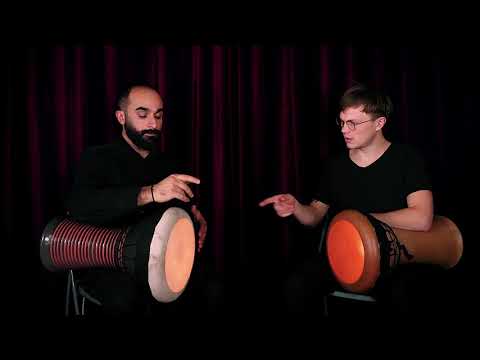
Hakan Kaya: 6 + 8 pattern exercise
Turkish percussionist · Intermediate / advanced exercise
Watch & try. Watch how Hakan fits groups of attacks into a longer groove.
Sonika Percussion · Hakan Kaya · 6 + 8 pattern exercise (English)
Egyptian and Turkish approaches
Turkish style. Modern Turkish split-hand playing uses the index and ring fingers of both hands to create many stroke combinations. Hakan Kaya distinguishes it from the older fiske style and credits Mısırlı Ahmet with developing the approach. It is commonly used on clay darbukas and can also be played on metal instruments. Here “Turkish style” identifies this approach rather than every technique used in Turkey. [6]Hakan Kaya · Fiske and split-hand (English)learndarbuka.com[7]Omar Kattan · Maksum with split-hand rollsyoutube.com
Find a clear individual index-finger and ring-finger sound before linking them. Follow a demonstration for the hand rotation and the order of a particular roll. Listen for balanced rim sounds and a smooth handover between hands.
Work on a short fragment from the demonstration, pause, and repeat at the same pace. Extend it only while each stroke remains clear.
Egyptian style. Explore the Egyptian roll through Qarshi / Rak, then hear how it decorates a rhythm. Omar Kattan’s Saidi lesson combines Egyptian rolls with split-finger playing, showing how the approaches can meet in one phrase. [8]Omar Kattan · Saidi patterns IIyoutube.com[1]Omar Kattan · Rak / Qarshi demonstrationyoutube.com
Keep the main Dum and Tak accents easy to recognise while the finger roll adds detail around them. Listen for the rhythm continuing clearly underneath the ornament, with the next main accent arriving on time.
Play one plain Saidi cycle. On the next cycle, add a short roll before one accent. Alternate plain and decorated cycles.
 Watch demonstration
Omar Kattan: decorate a Saidi phrase
Percussionist with Syrian roots · Saidi patterns II
Watch & try. Follow the main Saidi accents while the finger rolls add detail. Copy one decoration and return to a plain cycle to check the timing.
Omar Kattan Percussion · Omar Kattan · Saidi patterns II
Turning bursts into sustained rolls
Sustained rolls / rash (الرشّ). A sustained roll keeps a stream of attacks going. Nasser calls the technique rash and emphasises clear contact and balance between the hands. He recommends staying at a manageable speed until the movement settles, then making the motion smaller as speed increases. Hakan’s curriculum distinguishes single-stroke, triplet and long-tremolo exercises. [9]Nasser Salameh / i‘zif · Rolling strokes (Arabic)izif.com[5]Hakan Kaya · Finger exercises and rolls (course outline, English)learndarbuka.com
Keep the movement small and relaxed. Give the roll a clear beginning and ending, and maintain the same pulse as you change its length. Listen for an even flow without a loud bump at each hand change.
Roll for one beat and rest for one beat. Then try two beats of roll and two beats of rest at the same comfortable pace.
What the roll does in the phrase
A flourish and a subdivision. A compact flourish can lead into a landing note; a measured roll places each attack in a subdivision of the beat. In the six-note exercise here, three evenly spaced notes fill each beat. Count “1 trip let, 2 trip let” so the roll takes two beats regardless of how fast the fingers move. [5]Hakan Kaya · Finger exercises and rolls (course outline, English)learndarbuka.com
Decorating the cycle. Nasser’s rash lesson demonstrates accents inside rolls and advises against decorating every available space. Choose one arrival point, play the rhythm plainly, then add a short roll before it. Return to a plain cycle to hear whether the next Dum still lands on time. [9]Nasser Salameh / i‘zif · Rolling strokes (Arabic)izif.com
Names depend on the teacher. Rash, tremolo, Rak / Qarshi and split-hand describe different teaching ideas: a flowing texture, a short flourish or a way of moving the fingers. Compare the demonstrated hand order, attack count and timing. Egyptian and Turkish approaches can meet within one phrase, as Omar’s Saidi lesson shows. [9]Nasser Salameh / i‘zif · Rolling strokes (Arabic)izif.com[1]Omar Kattan · Rak / Qarshi demonstrationyoutube.com[6]Hakan Kaya · Fiske and split-hand (English)learndarbuka.com[8]Omar Kattan · Saidi patterns IIyoutube.com
Build the roll, then place it.
Watch one demonstration slowly. Identify the hand and finger for every contact before trying to join the notes.
Practise a short burst with a pause between repeats. Use a comfortable pace where each attack stays clear.
Choose one landing note in a familiar rhythm. Add the roll before it, then return to a plain cycle and check your timing.
Sources & further reading · 9 references
- Omar Kattan · Rak / Qarshi demonstration
- Omar Kattan · Biography and Syrian roots
- Omar Kattan · Five- to seven-stroke rolls
- Hakan Kaya · 6 + 8 pattern exercise (English)
- Hakan Kaya · Finger exercises and rolls (course outline, English)
- Hakan Kaya · Fiske and split-hand (English)
- Omar Kattan · Maksum with split-hand rolls
- Omar Kattan · Saidi patterns II
- Nasser Salameh / i‘zif · Rolling strokes (Arabic)