Instruments
Meet the voices that make the music.
Meet the instruments.
From deep bass to bright cymbals, each instrument brings a different sound to the group.
The five percussion voices below are available in this lab. A traditional takht (تخت) commonly has oud, qanun, nay and violin with riq; the instruments heard together depend on the repertoire and the ensemble. [1]MaqamWorld · Instruments of the takht (Arabic)maqamworld.com
Darbuka (دربوكة)
Goblet drum · tabla / doumbek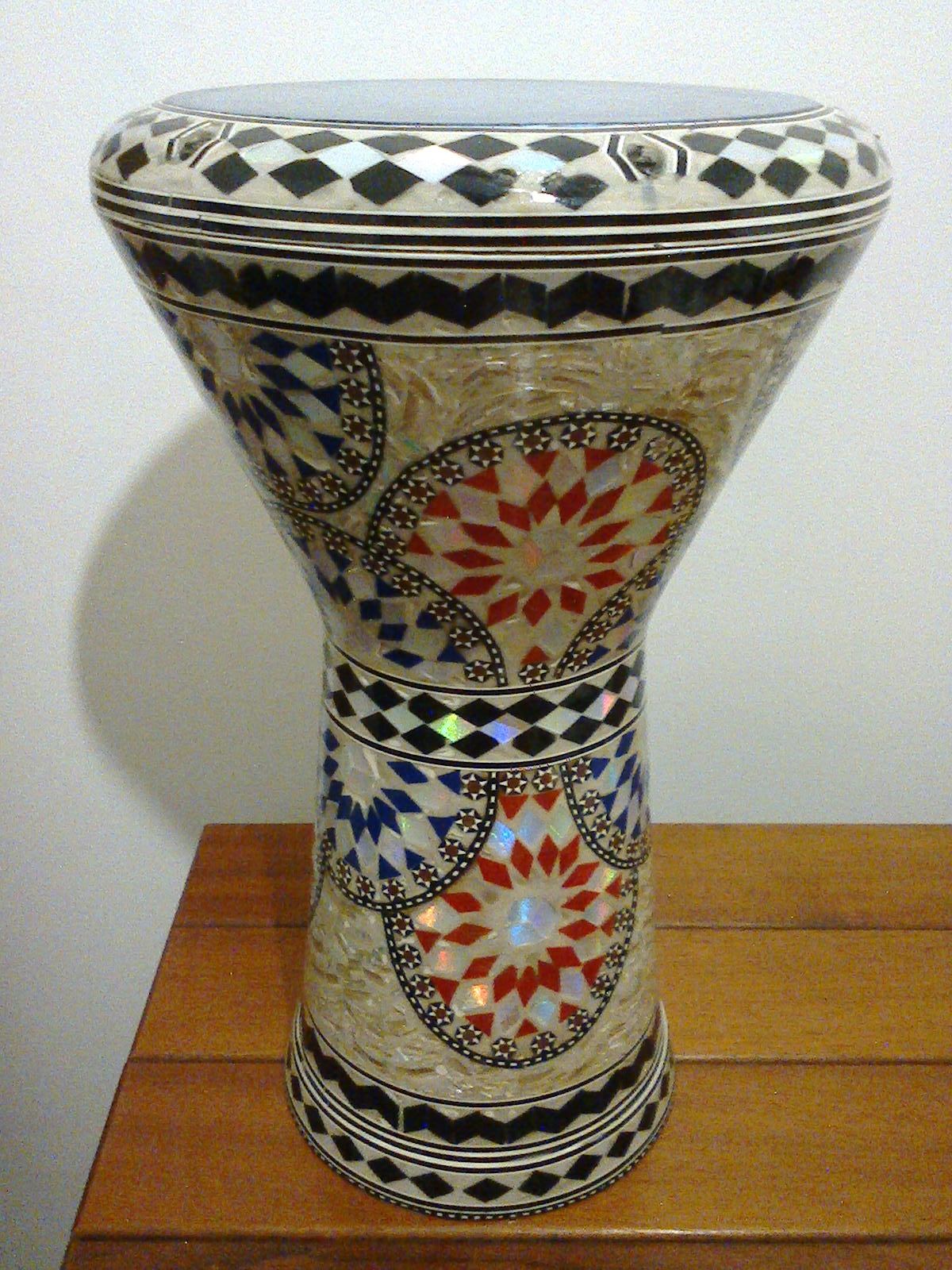 Open the original photo ↗
Rounded rim and a narrow waist.
Also called tabla (طبلة), or darbakeh (دربكة) in some Levantine sources. The contrast between a resonant Dum and a clear rim tone gives this drum its voice. Traditional clay examples use natural skins; many modern Egyptian instruments use aluminium and a tunable plastic head. You’ll hear it in folk, popular and raqs sharqi (رقص شرقي), or Eastern dance, music, as well as in some classical settings. [2]MaqamWorld · Tabla / darbuka (Arabic)maqamworld.com[3]Arab Music Academy magazine · Instruments in Libya (Arabic)arabmusicmagazine.org[4]Nayef al-Zoubi / Jordanian Ministry of Culture · Folk instruments (Arabic)ich.gov.jo
Follow the main strokes first. Then notice how quieter notes connect them without hiding the shape of the rhythm.
Dahola (دُهُلَّة)
Bass goblet drum · dohola / doholla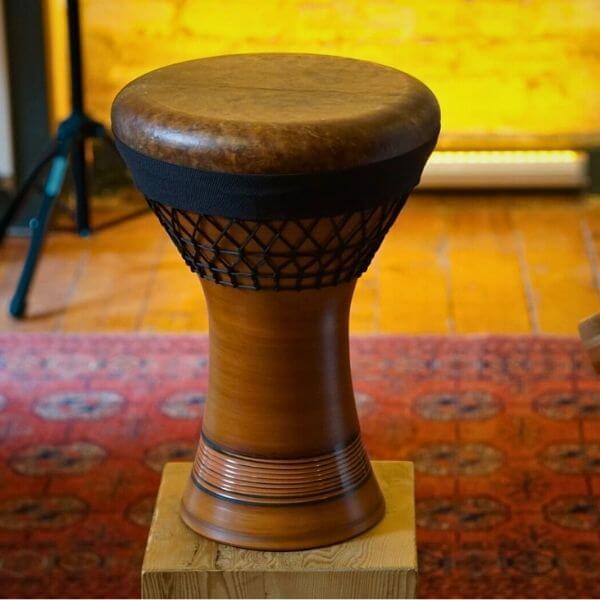 Open the original photo ↗
Clay bass goblet drum.
A larger member of the darbuka family, with a deeper, bassier voice. Nayef al-Zoubi’s Jordanian account records the Egyptian name duhulla and its use alongside tabla in folk percussion groups. In this lab it provides the low foundation underneath the lead darbuka; think of it as a second voice in the same family. [4]Nayef al-Zoubi / Jordanian Ministry of Culture · Folk instruments (Arabic)ich.gov.jo
Compare its Dum with the lead drum, then hear how the two low strokes sit together. A fuller sound does not have to mean more notes.
Bendir (بندير)
Frame drum · North African traditions Open the original photo ↗
A wide head on a wooden frame.
A broad frame drum used in North African traditions. The Arab Music Academy’s Libyan account describes a wooden hoop with a goatskin head and, in some examples, two strings underneath that add a buzz. It documents the bendir in Amazigh songs, folk music and hadra (حضرة), a devotional gathering. The buzzing strings are one useful distinction from a drum whose brightness comes from metal jingles. [3]Arab Music Academy magazine · Instruments in Libya (Arabic)arabmusicmagazine.org[5]MaqamWorld · Daff and regional frame-drum names (Arabic)maqamworld.com
Listen for the body of the sound after the initial attack. Compare that broader texture with the more sharply defined goblet-drum strokes.
Riq (رقّ)
Small frame drum with cymbals · riqq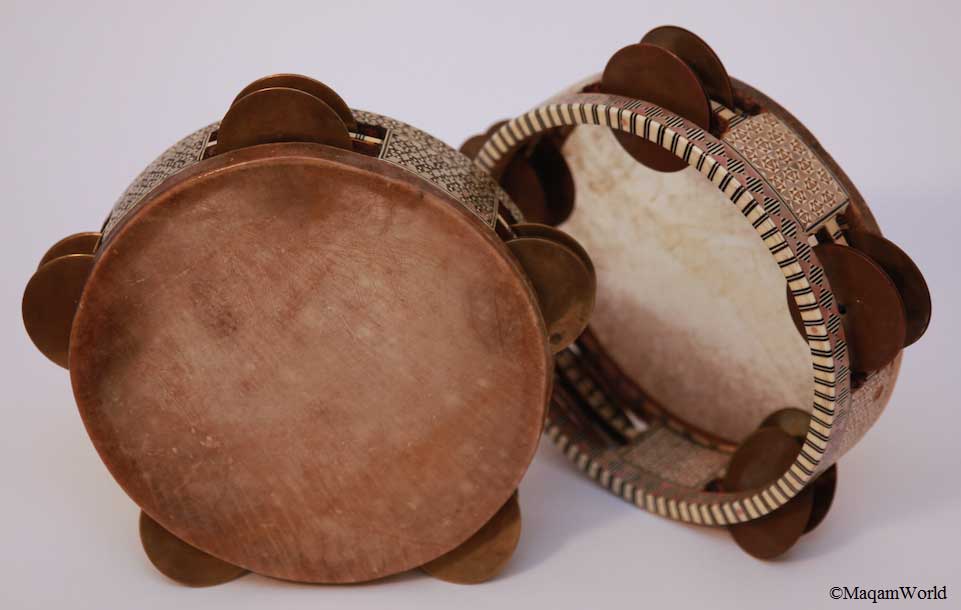 Open the original photo ↗
A drumhead with pairs of metal jingles.
The riq combines a drumhead with sets of brass cymbals. A player can bring out the skin, frame or metal for very different colours, from delicate articulation to a bright shimmer. In a traditional takht (تخت) it is often the main, or only, percussion instrument. MaqamWorld calls its player dabit al-iqa‘ (ضابط الإيقاع), the musician who holds the rhythm together while shaping its ornaments. [6]MaqamWorld · Riqq, its sounds and the rhythm leader (Arabic)maqamworld.com
Follow the balance between the drumhead and the jingles. In the linked performances, notice how much expression one small instrument can provide.
Sagats (صاجات)
Finger cymbals · sagat / sajat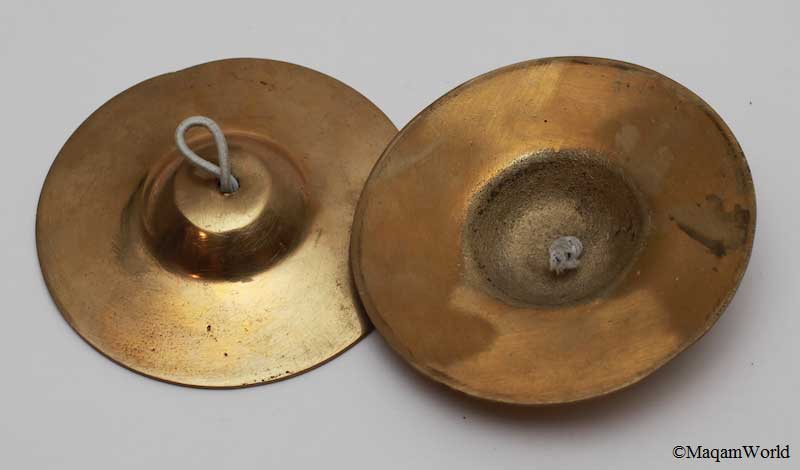 Open the original photo ↗
Small metal cymbals with finger loops.
These small brass cymbals are attached to the thumbs and middle fingers of both hands and struck together. They add ringing accents and rhythmic detail, and are closely associated with raqs sharqi performance. You may see the English spellings sagat and sajat for this Arabic name. Larger related cymbals are known as tura (طورة). [7]MaqamWorld · Sagat and tura (Arabic)maqamworld.com
Compare an open ring with a short, damped tap. Listen for how the length of the ring changes the space around the drums.
 Watch demonstration
Adel Shams el-Din: the voices of the riq
Egyptian percussionist · Solo performance, 2005
Watch & try. Listen once for the drumhead and again for the cymbals. Follow how Adel changes the texture while keeping a rhythmic phrase recognisable.
Riqqlover · MaqamWorld · Riqq and Egyptian performers
The melody around the rhythm
The four familiar melodic voices of a takht, plus the buzuq heard in some ensembles. Listen for the contrast between plucked attacks and the sustained sounds of bow or breath.
Oud (عود)
A rounded wooden body and short, fretless neck give the oud its recognisable shape. A plectrum, or risha (ريشة), plucks the strings. The fretless fingerboard lets a player place the pitches of a maqam precisely. Listen for the plucked attack, decay and rhythmic shape of the melody. [8]MaqamWorld · Oud (Arabic)maqamworld.com
Qanun (قانون)
Groups of strings cross a flat, trapezoidal soundboard. Plectra mounted on the index fingers pluck the strings; small levers, called ‘urab (عُرَب), change their pitches for the maqam or a melodic transition. Listen for its bright articulation and flowing runs. [9]MaqamWorld · Qanun and pitch levers (Arabic)maqamworld.com
Nay (ناي)
An open-ended cane flute played at an angle to the mouth, with six front finger holes and one rear thumb hole. Players use different lengths of nay for different pitch ranges. Its breathy tone and changing colour can make a sustained note as expressive as a fast phrase. [10]MaqamWorld · Nay (Arabic)maqamworld.com
Violin / kaman (كمان)
The violin has an established place in Arabic music, with its own approaches to tuning and ornamentation. One common Arabic tuning is G–D–G–D from low to high, although players use other tunings too. Its fretless fingerboard accommodates the pitches of the maqam. Listen for sustained tones, slides and subtle changes of pitch. [11]MaqamWorld · Arabic violin (Arabic)maqamworld.com
Buzuq (بُزُق)
A smaller body, long neck, metal strings and movable frets distinguish the buzuq from the oud. Associated with the Levant, it is heard in solo playing and in some takht and popular-music ensembles. Its bright, ringing sound makes an interesting contrast with the warmer oud. [12]MaqamWorld · Buzuq (Arabic)maqamworld.com
More names you’ll hear
Frame-drum names overlap across regions, while folk celebrations bring other instruments into the group. These examples help you recognise those differences.
Daff (دفّ)
Daff names a circular frame drum, but regional usage overlaps with bendir, tar (طار) and sometimes riq. Check the construction as well as the label: the presence of jingles or buzzing strings changes what you hear. Frame drums accompany devotional singing as well as traditional, folk and popular music. [5]MaqamWorld · Daff and regional frame-drum names (Arabic)maqamworld.com[6]MaqamWorld · Riqq, its sounds and the rhythm leader (Arabic)maqamworld.com
Mazhar (مزهر)
The Egyptian mazhar described by MaqamWorld is a heavy, loud frame drum with metal jingles. It suits larger percussion groups and wedding zaffa (زفّة) processions. Listen for the combined weight of the head and the ringing metal; it has a different ensemble role from a delicately played riq. [13]MaqamWorld · Egyptian mazhar and wedding ensembles (Arabic)maqamworld.com
Tabl baladi (طبل بلدي)
A large wooden drum carried on a strap and played with a thick stick for bass and a thin stick for higher strokes. It is heard at outdoor celebrations and in dabke (دبكة), often beside a loud mizmar (مزمار). The stick attacks make a useful listening contrast with the darbuka’s hand-played strokes. [14]MaqamWorld · Tabl baladi and folk celebrations (Arabic)maqamworld.com
Mijwiz (مجوز)
Two joined cane pipes form this folk wind instrument. Nayef al-Zoubi documents it in rural celebrations across Jordan, Palestine, Syria and Lebanon. It belongs to another sound world alongside the softer nay of the takht: listen for the close, bright sound of the paired pipes. [4]Nayef al-Zoubi / Jordanian Ministry of Culture · Folk instruments (Arabic)ich.gov.jo
Sources & further reading · 14 references
- MaqamWorld · Instruments of the takht (Arabic)
- MaqamWorld · Tabla / darbuka (Arabic)
- Arab Music Academy magazine · Instruments in Libya (Arabic)
- Nayef al-Zoubi / Jordanian Ministry of Culture · Folk instruments (Arabic)
- MaqamWorld · Daff and regional frame-drum names (Arabic)
- MaqamWorld · Riqq, its sounds and the rhythm leader (Arabic)
- MaqamWorld · Sagat and tura (Arabic)
- MaqamWorld · Oud (Arabic)
- MaqamWorld · Qanun and pitch levers (Arabic)
- MaqamWorld · Nay (Arabic)
- MaqamWorld · Arabic violin (Arabic)
- MaqamWorld · Buzuq (Arabic)
- MaqamWorld · Egyptian mazhar and wedding ensembles (Arabic)
- MaqamWorld · Tabl baladi and folk celebrations (Arabic)