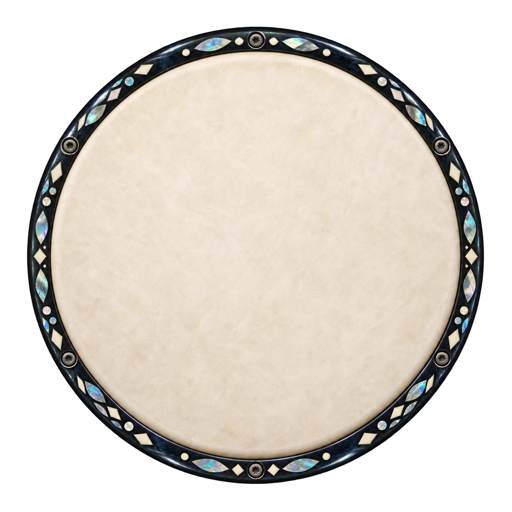
History of the darbuka.
From ancient clay drums to the music we play today.
A deep Dum. A sharp Tak. With just a few sounds, the darbuka can support a song, lead a dance or fill a stage on its own. Its story reaches from clay pots and animal skins to metal workshops, concert halls and online lessons. Along the way, people across the Arab world and Türkiye have shaped how it looks, sounds and is played.
Explore this article5 topics
The drum and its origins
The darbuka (دربوكة) is a hand drum shaped like a goblet: wide at the top, narrow in the middle and open at the bottom. A skin or plastic sheet stretches across the top. This is the head. When you strike it, it vibrates and makes the sound. The hollow body helps that sound carry. [1]Dar el Oud, Tunis · The darbouka (Arabic)dareloud.tn
In Egypt, it is usually called a tabla (طبلة). In the Levant, which includes Syria, Lebanon, Palestine and Jordan, you may hear darbake or dirbakki (دربكة). Turkish names include darbuka, dümbek and dümbelek. Darbouka is a common spelling in North Africa. The Egyptian tabla is different from the pair of drums called tabla in Indian music. [2]MaqamWorld · Arabic tabla reference (English)maqamworld.com[3]Turkish Ministry of Culture · Darbuka (English)ktb.gov.tr[4]Esra Karaol & Nilgün Doğrusöz · Darbuka history and technique (2014, PDF)dergipark.org.tr
Know the parts.
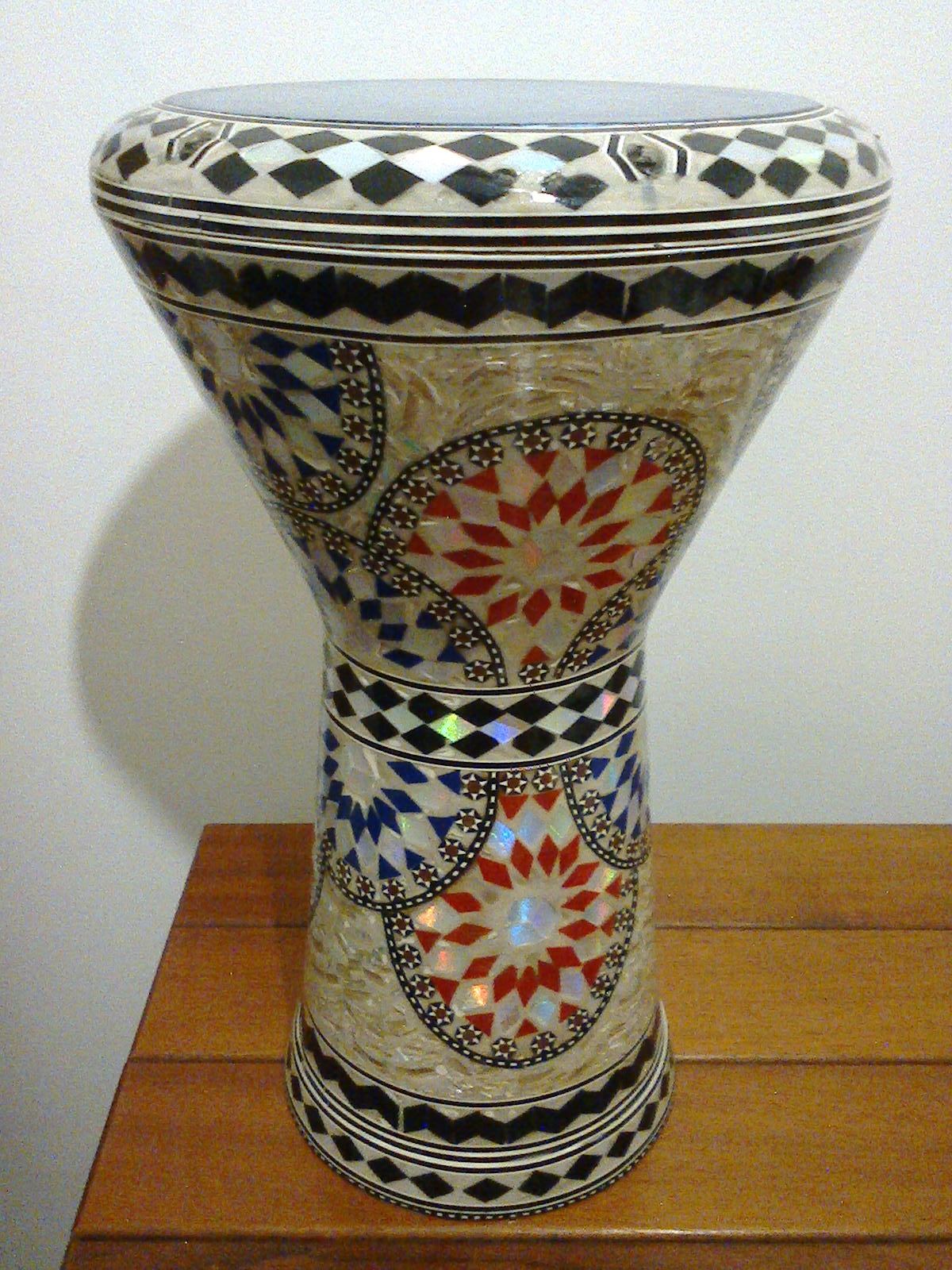
- 1Head
- The stretched skin or plastic sheet you strike to make a sound.
- 2Rim
- The edge around the head. Its shape affects how your hands meet the drum.
- 3Shell
- The hollow body under the decoration.
- 4Waist
- The narrow part of the goblet shape, between the bowl and the foot.
- 5Foot / open base
- The lower end widens out again. It has an open bottom, with no second drumhead.
A Cairo-made darbuka with a rounded rim and decorated body, photographed in 2013.
Photograph: Siffert80 · Darbuka do Cairo · Annotations: Practice Lab · CC BY-SA 4.0
Its ancestors may go back thousands of years. The basic idea was simple: make a hollow body from clay, cover one end with skin and strike it by hand. Türkiye’s Ministry of Culture links drums like the darbuka to ancient Anatolia, Mesopotamia and Central Asia. Anatolia is mostly in modern Türkiye; Mesopotamia lay mainly in modern Iraq and parts of Syria. [3]Turkish Ministry of Culture · Darbuka (English)ktb.gov.tr
One estimate puts possible clay-drum ancestors around 1700 BCE, about 3,700 years ago. Turkish researcher Esra Karaol connects this date with remains from the Assyrian trading-colony period. The modern darbuka’s exact birthplace and invention date remain unknown. [5]Esra Karaol · The clay darbuka: history and making (2013)arastirmax.com
Clay can survive long after skin and cords have rotted away, leaving few clues about how early drums sounded or how people played them. [4]Esra Karaol & Nilgün Doğrusöz · Darbuka history and technique (2014, PDF)dergipark.org.tr
In the 1600s, the Ottoman traveller Evliya Çelebi described pottery drums called dümbelek in Egypt. These references, discussed in Songül Çakmak’s research, give us a firmer view of clay drums in everyday musical life. [6]Songül Çakmak · Clay darbuka making and playing (2024, Turkish)dergipark.org.tr
By the 1800s, accounts of Tunis describe the darbouka in café groups with oud, rabab and frame drums. Music moved between communities, and the drum was part of that shared life. [7]Abir al-Sharif · Music in nineteenth-century Tunis (Arabic)folkculturebh.org
The darbuka through time
BCE means “before the Common Era”.
- Around 1700 BCEPossible ancestors
Early clay drums
Karaol links remains from the Assyrian trading-colony period to possible roots of the clay darbuka. [5]Esra Karaol · The clay darbuka: history and making (2013)arastirmax.com
- 1600s
An Ottoman traveller describes pottery drums
Evliya Çelebi’s accounts refer to clay dümbelek in Egypt. [6]Songül Çakmak · Clay darbuka making and playing (2024, Turkish)dergipark.org.tr
- 1800s
The darbouka in Tunisian cafés
Accounts of music in Tunis place it beside strings and other percussion, played by musicians from different communities. [7]Abir al-Sharif · Music in nineteenth-century Tunis (Arabic)folkculturebh.org
- 1930s
A familiar sound in Istanbul
Turkish researchers describe its popularity in the city’s music. Hasan Tahsin Parsadan helped bring it into professional music circles. [4]Esra Karaol & Nilgün Doğrusöz · Darbuka history and technique (2014, PDF)dergipark.org.tr
- 1930s–1950s
Cairo’s dance stages and film stars
Badia Masabni’s shows helped launch dancers such as Tahiyya Carioca and Samia Gamal. Their stage and film work made Egyptian dance widely known. [8]Hossam Ramzy · Badia Masabni and Cairo’s dance stageshossamramzy.com
- 1963–1964
Tunisian instruments are recorded for teaching
Tunisia’s national sound archive holds a Rachidiyya recording about the darbouka and other instruments from these years. [9]CMAM, Tunisia · Rachidiyya instrument recording, 1963–64phonotheque.cmam.tn
- 1970s–1980sA maker’s account
New finishes for clay and metal drums
Gawharet El Fan’s history describes adding mother-of-pearl designs to clay drums, then using them on metal bodies. [10]Gawharet El Fan · An Egyptian maker’s designs (English)gawharetelfan.com
- 1980s–1990s
Clay drums inspire new ways to play
Egyptian clay drums gain new interest in Türkiye. Mısırlı Ahmet’s fast finger technique helps make them popular with a new generation. [4]Esra Karaol & Nilgün Doğrusöz · Darbuka history and technique (2014, PDF)dergipark.org.tr
- 1993A maker’s account
The larger Sombaty model
Gawharet El Fan dates its Sombaty to this year. Its larger head gives players more room for their hands. [10]Gawharet El Fan · An Egyptian maker’s designs (English)gawharetelfan.com
- 1994–1996
Egyptian percussion joins a major rock project
Hossam Ramzy brings Arab musicians to Page and Plant’s No Quarter recording, then joins their 1995–96 tour. [11]Hossam Ramzy · Biography and collaborations (English)hossamramzy.com
- 2007
A home for learning together in Istanbul
Mısırlı Ahmet opens Galata Ritimhanesi. Players learn through shared practice, new phrases and their own ideas. [12]Uğur Aslan · Mısırlı Ahmet and musical status (2016, PDF)dergipark.org.tr
- 2023
A percussion ensemble on the concert stage
Cairo Opera House presents Sa‘id al-Artist and his group on 2 September: an example of percussion taking the lead. [13]Cairo Opera House · Sa‘id al-Artist and his ensemble, 2023 (Arabic)cairoopera.org
- Today
Local craft meets worldwide learning
Potters still make clay drums, while players also learn through online courses and international workshops. [6]Songül Çakmak · Clay darbuka making and playing (2024, Turkish)dergipark.org.tr[14]Nasser Salameh / i‘zif · Course outline (Arabic)izif.com[15]Omar Kattan · Biography and Syrian rootsomarkattanpercussion.com
Regional traditions
The darbuka is especially at home in Egypt, the Levant, North Africa and Türkiye. It is also heard in the Balkans and in music communities around the world. There is no reliable country-by-country count of players in these sources. Its place in songs, celebrations and dance gives us a better picture. [3]Turkish Ministry of Culture · Darbuka (English)ktb.gov.tr[4]Esra Karaol & Nilgün Doğrusöz · Darbuka history and technique (2014, PDF)dergipark.org.tr
Egypt. The tabla supports folk songs, popular music and dance. It also appears in some classical music groups. A large, low-sounding drum called a dahola can play alongside a smaller tabla. One can hold the deep pulse while the other adds detail. [2]MaqamWorld · Arabic tabla reference (English)maqamworld.com[16]Nayef al-Zoubi / Jordanian Ministry of Culture · Folk instruments (Arabic)ich.gov.jo
The Levant. Jordanian researcher Nayef al-Zoubi describes the drum in festive songs, dabke (دبكة), a group line dance, and wedding processions called zaffa (زفّة). [16]Nayef al-Zoubi / Jordanian Ministry of Culture · Folk instruments (Arabic)ich.gov.jo
Türkiye. The drum belongs to folk music, city entertainment and modern percussion groups. Women have long played clay dümbek in western Anatolia. Alongside these local traditions, professional players have developed many ways to use the fingers and shape a solo. [6]Songül Çakmak · Clay darbuka making and playing (2024, Turkish)dergipark.org.tr[17]Hakan Kaya · Fiske and split-hand (English)learndarbuka.com
North Africa. In Tunisia, the darbouka is used in family music, popular groups and classical orchestras. In Morocco, it helps keep the rhythm in al-ala (الآلة), a local Andalusian music tradition. Libyan accounts also describe clay drums with skin heads. Each place has its own music and ways of playing. [1]Dar el Oud, Tunis · The darbouka (Arabic)dareloud.tn[18]Khalid Hilali · The Moroccan al-ala ensemble (Arabic)folkculturebh.org[19]Arab Music Academy magazine · Instruments in Libya (Arabic)arabmusicmagazine.org
Materials and making
The body, head and rim all matter. They affect the weight, feel and sound of a drum. A shiny surface tells only part of the story: under the decoration there may be a body of clay, aluminium or another material. [20]Sala Muzik · Materials, heads and care (English)salamuzik.com
A clay body is shaped, dried and fired in a kiln to make it hard. A natural skin can then be fixed over the opening with glue and cords. Çakmak’s research follows this craft in Avanos, Türkiye, including the work of maker Mehmet Körükçü. Clay drums are still made and played today. [6]Songül Çakmak · Clay darbuka making and playing (2024, Turkish)dergipark.org.tr
Natural heads can be made from goat or fish skin. The Sonika drum below uses fish skin. Look at the rounded bowl, narrow waist and cords: the same basic parts you saw on the decorated drum are much easier to spot here. [20]Sala Muzik · Materials, heads and care (English)salamuzik.com[21]Sonika Percussion · A clay darbuka with a fish-skin headsonikapercussion.com
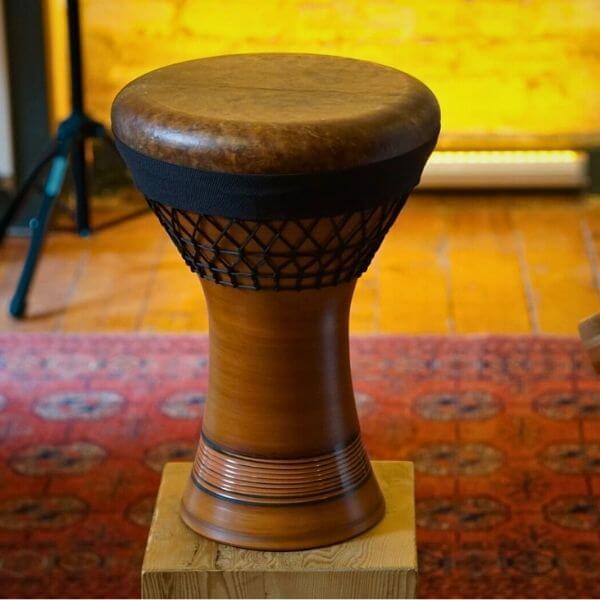 Photo unavailable here. Open the original ↗
Clay and skin, still in use today. This modern Sonika drum has a clay body, a fish-skin head and cords around the bowl. The rings near its foot make the pottery easy to see.
A 2018 report from an Alexandria workshop follows aluminium through the making process. Workers melt the metal and pour it into a sand mould. Once it has cooled, they remove the casting and smooth it on a lathe, a machine that turns the body while it is worked. They then finish the surface and fit a plastic head with screws. [22]Nabil Abu Shal · Inside an Alexandrian drum workshop (2018, Arabic)almasryalyoum.com
 Photo unavailable here. Open the original ↗
Before the decoration: aluminium shells in Osama Magdy’s Alexandria workshop, photographed for a 2018 report. With no heads fitted, you can look into the hollow bowls and see the narrow openings below.
The open shells in the photograph show what decoration usually hides. Each body is hollow, with a broad bowl that narrows into a tube. There is no second drumhead underneath. Paint or small pieces of mother-of-pearl (صدف), the shiny inside layer of a shell, can cover the outside. [22]Nabil Abu Shal · Inside an Alexandrian drum workshop (2018, Arabic)almasryalyoum.com[10]Gawharet El Fan · An Egyptian maker’s designs (English)gawharetelfan.com
Natural skin responds to damp air and temperature. Players have traditionally warmed it to bring back a tighter sound. Synthetic heads are less affected by humidity and are often tightened with screws. Sala Muzik’s guide explains these differences. The head, its tension and your touch all help shape the sound. [20]Sala Muzik · Materials, heads and care (English)salamuzik.com
| Part | Common choices | Why it matters |
|---|---|---|
| Body | Clay, aluminium or copper | Changes the weight, strength and sound. |
| Head | Animal skin or a synthetic sheet | Changes the touch and how the drum reacts to the weather. |
| Rim & tuning | Rounded or more exposed edges; fixed skin or screw tuning | Changes the contact with your hands and how you adjust the head. |
| Finish | Plain, painted, engraved or covered with shell pieces | Adds colour, pattern and texture. |
Sombaty is a common name for a larger darbuka. A dahola is usually larger again and has a deeper voice. Gawharet El Fan’s own history dates its Sombaty model to 1993. Designs and sizes continue to change alongside players’ needs. [23]Donizetti · Standard, Sombaty and Dohola (Turkish)donizettidarbuka.com[10]Gawharet El Fan · An Egyptian maker’s designs (English)gawharetelfan.com
Rhythm, dance and performance
Start with Dum (دُم), the low sound, and Tak (تك), the bright sound near the edge. In his Arabic lessons, Jordanian percussionist Nasser Salameh teaches players to let the hand bounce away so the head can ring. Holding the drum comfortably and making a clear sound come before speed. [24]Nasser Salameh / i‘zif · Dum and Tak (Arabic)izif.com
A repeating rhythm pattern is called an iqa‘ (إيقاع); the plural is iqa‘at (إيقاعات). The strong low and high strokes help give each pattern its character. A player can add little strokes between them, change an accent or leave a gap. Those choices make a simple pattern feel alive. [25]MaqamWorld · Rhythmic cycles and ornamentation (English)maqamworld.com
Try listening for two things at once: the steady pattern and the extra details. Can you keep tapping the main beat when the drummer adds a quick roll? This is a useful way to hear how a player can be creative while still supporting a song or dance.
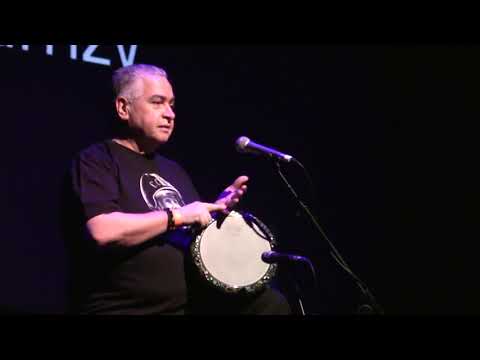 Watch demonstration
Hossam Ramzy introduces the tabla
Egyptian percussionist · Interview and demonstration
Watch & try. Listen for the low Dum and bright Tak. Then notice how Hossam Ramzy puts them together into short musical phrases.
Sound Gallery Studios · MaqamWorld · Arabic tabla reference (English)
The darbuka and belly dance
Belly dance is a major part of the darbuka’s story. In Egypt, the stage form is usually called raqs sharqi (رقص شرقي), meaning “Eastern dance”. The tabla gives dancers a clear pulse, sharp accents and rolling sounds to move with. It is also one voice in a larger group of instruments. [2]MaqamWorld · Arabic tabla reference (English)maqamworld.com[8]Hossam Ramzy · Badia Masabni and Cairo’s dance stageshossamramzy.com
Egyptian baladi (بلدي) means local or “of the country” and is used for home-grown music and dance. Cairo’s stage shows gave dance a different setting, with arranged music, larger bands and planned entrances and endings. Hossam Ramzy describes how Badia Masabni’s shows brought together singers, musicians and dancers. Stars such as Tahiyya Carioca and Samia Gamal then became famous through theatre and film. [8]Hossam Ramzy · Badia Masabni and Cairo’s dance stageshossamramzy.com
A tabla solo gives the dancer and drummer a moment to work closely together. A low beat can mark a strong movement. A run of quick strokes can support a shimmy. A sudden stop can make a pause feel dramatic. The excitement comes from how the sounds and movements fit together. [26]Hossam Ramzy · Drumming for dancers (2007)hossamramzy.com
In his account of dancer Nagwa Fouad’s music, Ramzy highlights Mahmoud Hammouda, a tabla player in Abdel Halim Hafez’s orchestra, and Ahmed Hammouda, who played with Fouad. He describes solos built as musical sections, with changing rhythms and clear endings. These players helped shape the featured drum solo. [27]Hossam Ramzy · Nagwa Fouad and her musicians (English)hossamramzy.com
Ramzy’s advice is to follow the whole piece. When a flute or another instrument has a quiet solo, keep the rhythm simple and leave space. When the full band grows louder, the drumming can grow too. The dancer responds to melody and mood as well as beats. Playing more notes is not always more helpful. [26]Hossam Ramzy · Drumming for dancers (2007)hossamramzy.com
Next time you watch a dance performance, notice a pause, a change of rhythm and an ending. Watch how the dancer responds to each one. Then listen for the tabla while the melody is playing. Its supporting role matters just as much as its solo.
A leading voice on stage
The darbuka can also lead a concert without a dancer. In a percussion group, several players can share a pattern, pass a phrase between them or take turns as soloist. MaqamWorld’s Egyptian performance examples show how much variety a group can create with closely related drums. [2]MaqamWorld · Arabic tabla reference (English)maqamworld.com
Sa‘id al-Artist is a well-known Egyptian player and bandleader. Cairo Opera House’s programme for 2 September 2023 lists him with his ensemble. Concerts like this put the drummers at the centre of the performance, where the audience can follow their sounds and hand movements. [13]Cairo Opera House · Sa‘id al-Artist and his ensemble, 2023 (Arabic)cairoopera.org
 Watch demonstration
Sa‘id al-Artist and his percussion ensemble
Egyptian percussionist · Al-Geneina Theatre performance
Watch & try. Choose one player to follow. Notice when the group plays together and when a single drum comes forward.
Nahed Samir · MaqamWorld · Arabic tabla reference (English)
New techniques and a worldwide audience
Older and newer techniques exist side by side. Turkish teacher Hakan Kaya explains fiske, a finger-flick stroke used in established Turkish playing, and split-hand playing, which separates the finger movements to make quick, even strokes. The shape of the rim affects which movements feel comfortable. [17]Hakan Kaya · Fiske and split-hand (English)learndarbuka.com
Mısırlı Ahmet, born Ahmet Yıldırım in Ankara, became known for a fast split-finger approach on clay drums. He spent time in France and Egypt, and later worked with musicians from other traditions. His nickname means “Egyptian Ahmet”. His career is a good example of ideas moving between countries through listening, travel and shared music. [12]Uğur Aslan · Mısırlı Ahmet and musical status (2016, PDF)dergipark.org.tr
Players combine older and newer ideas. A beginner may learn a few clear strokes; a soloist may combine finger rolls, slaps and quick changes of sound. Egyptian and Turkish approaches often meet in the same performance. [17]Hakan Kaya · Fiske and split-hand (English)learndarbuka.com
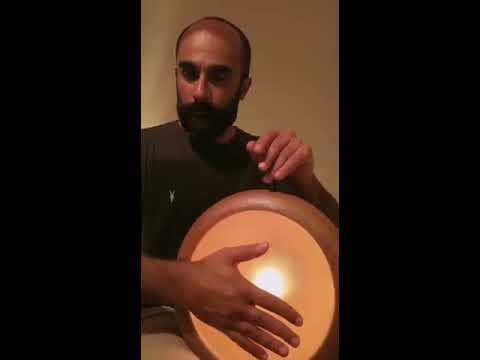 Watch demonstration
Hakan Kaya: a 2/4 groove with ornaments
Turkish percussionist · Group lesson demonstration
Watch & try. First tap the main beat. On a second listen, follow the small strokes around it. Notice how a short rhythm grows more detailed without losing its pulse.
Sonika Percussion · Hakan Kaya · A 2/4 groove with ornaments (English)
Recording and touring have brought Egyptian percussion to new listeners. Hossam Ramzy worked with Peter Gabriel and brought Arab musicians to Jimmy Page and Robert Plant’s No Quarter project. These collaborations placed the sounds of his musical background beside rock and other styles. [11]Hossam Ramzy · Biography and collaborations (English)hossamramzy.com
Teaching has travelled too. Galata Ritimhanesi in Istanbul became a place for group practice and personal ideas. Syrian percussionist Omar Kattan, based in Barcelona, teaches through workshops and online lessons. Students can now learn from musicians far from where they live. [12]Uğur Aslan · Mısırlı Ahmet and musical status (2016, PDF)dergipark.org.tr[15]Omar Kattan · Biography and Syrian rootsomarkattanpercussion.com
Nasser Salameh’s Arabic course at i‘zif shows how lessons can be organised step by step: basic sounds, rhythm patterns, then ways to join them together. Video also lets a learner watch a hand movement again and hear the same phrase several times. [14]Nasser Salameh / i‘zif · Course outline (Arabic)izif.com
That is why there is no single “finished” version of the darbuka. A clay drum at a family gathering, a metal drum in a dance band and a soloist teaching online are all part of its story. The instrument keeps changing as people make it, play it and pass it on.
Sources & further reading · 27 references
- Dar el Oud, Tunis · The darbouka (Arabic)
- MaqamWorld · Arabic tabla reference (English)
- Turkish Ministry of Culture · Darbuka (English)
- Esra Karaol & Nilgün Doğrusöz · Darbuka history and technique (2014, PDF)
- Esra Karaol · The clay darbuka: history and making (2013)
- Songül Çakmak · Clay darbuka making and playing (2024, Turkish)
- Abir al-Sharif · Music in nineteenth-century Tunis (Arabic)
- Hossam Ramzy · Badia Masabni and Cairo’s dance stages
- CMAM, Tunisia · Rachidiyya instrument recording, 1963–64
- Gawharet El Fan · An Egyptian maker’s designs (English)
- Hossam Ramzy · Biography and collaborations (English)
- Uğur Aslan · Mısırlı Ahmet and musical status (2016, PDF)
- Cairo Opera House · Sa‘id al-Artist and his ensemble, 2023 (Arabic)
- Nasser Salameh / i‘zif · Course outline (Arabic)
- Omar Kattan · Biography and Syrian roots
- Nayef al-Zoubi / Jordanian Ministry of Culture · Folk instruments (Arabic)
- Hakan Kaya · Fiske and split-hand (English)
- Khalid Hilali · The Moroccan al-ala ensemble (Arabic)
- Arab Music Academy magazine · Instruments in Libya (Arabic)
- Sala Muzik · Materials, heads and care (English)
- Sonika Percussion · A clay darbuka with a fish-skin head
- Nabil Abu Shal · Inside an Alexandrian drum workshop (2018, Arabic)
- Donizetti · Standard, Sombaty and Dohola (Turkish)
- Nasser Salameh / i‘zif · Dum and Tak (Arabic)
- MaqamWorld · Rhythmic cycles and ornamentation (English)
- Hossam Ramzy · Drumming for dancers (2007)
- Hossam Ramzy · Nagwa Fouad and her musicians (English)